前言
preface
李全凤的创作始终游走在媒介与自然之间。他不以单一绘画体系自限,而是以油画的肌理“立形”,以水墨的气韵“生意”:厚重的堆叠与刮擦构成画面的物质骨架,而晕染、留白与雾感,则让色彩在画布上流动、呼吸,形成一种介于可触与不可触之间的视觉张力。
在主题上,他将微观自然与宏观宇宙不断折叠——浪的涌动、岩的纹理、水的流向,与星云的旋臂、光的扩散彼此呼应。画面并非指向具体的物象,而是在捕捉一种更本质的节奏:自然与宇宙共享的运行频率。
他的笔触始终保持着“震颤”的状态。厚涂中蕴含推移的力量,刮擦里留有破碎的痕迹,散落其间的光斑既像浪花中的反光,也如宇宙脉冲的闪烁,使画面的运动感从视觉延伸至感知层面。
这种创作最终指向一种温柔而内敛的诗性——科学不再是冷峻的概念,自然也不止于被观看的对象。通过颜料的温度与节奏,宇宙被拉近至可感的距离,与水、岩、光一同,呈现出一种与人同频的存在状态。
Li Quanfeng’s work continually navigates the space between medium and nature. He does not confine himself to a single painting system; instead, he “builds form” through the texture of oil paint and “breathes life” through the spirit of ink. The dense layering and scraping create the material framework of the composition. At the same time, washes, reserved spaces, and misty effects allow color to flow and breathe on the canvas, generating a visual tension between the tangible and the intangible.
Thematically, he constantly folds the microcosm of nature into the macrocosm of the universe— the surge of waves, the texture of rocks, and the flow of water echo the spiral arms of nebulae and the diffusion of light. His works do not point to specific objects but seek to capture a more essential rhythm: the shared frequencies at which nature and the cosmos operate.
His brushwork is always in a state of subtle “vibration.” The thick layers carry the force of movement; the scratches leave fragmented traces; scattered specks of light resemble both the reflections on waves and the pulses of the universe, extending the sense of motion from the visual to the perceptual plane.
Ultimately, this approach cultivates a gentle and restrained poetic quality—science is no longer a cold abstraction, and nature is more than a mere object of observation. Through the warmth and rhythm of paint, the cosmos is brought within reach, existing in resonance with water, rock, and light, presenting a state of being attuned to humanity.
浪的白光触碰岩的深黑,尺度便不再重要。
在水与石的低语之间,在星尘与引力的回声之中,画面开启了一种介于自然与宇宙之间的感知通道——不是去辨认形象,而是去倾听震颤。
这件作品以意象为桥,将可触的肌理与不可见的节律并置:颜料成为感知的延伸,笔触化为时间与空间的回响。微观的水流与宏观的星云在同一瞬间折叠共存,构成一首无需语言的诗——引领观者走入那片既熟悉又陌生的境域,在凝视之中,感受自然与宇宙同频的呼吸。.
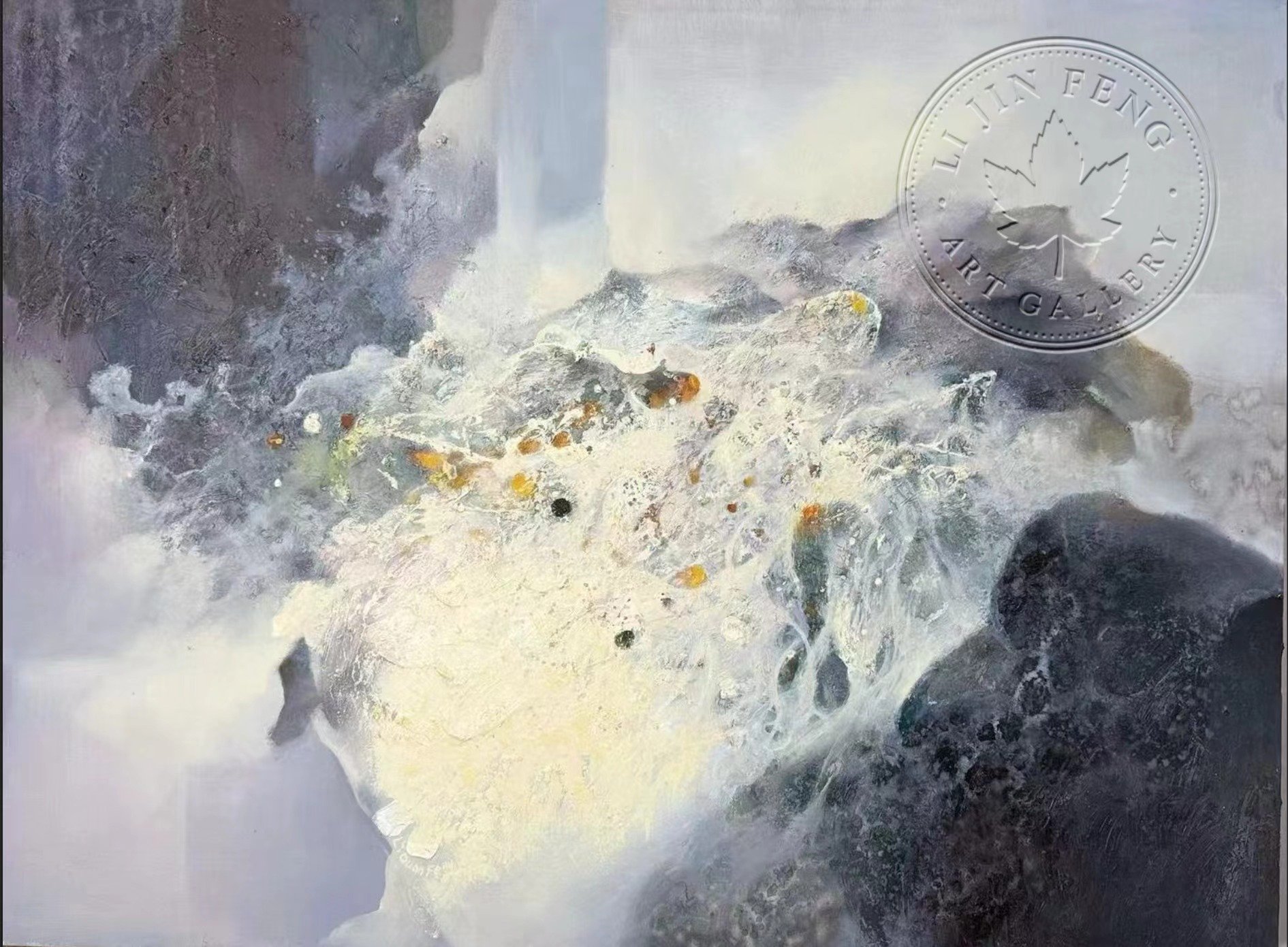
光与岩
90X120cm
白色的浪涌掠过深黑的岩层,浅紫的雾气与金色的微光在笔触间轻伏、颤动,一场跨越尺度的低语便悄然开启——一声来自山涧深处,水与石相触的震响;一声则来自星云之中,星粒碰撞的微妙回声。
这幅作品,是画家以“意象”写下的又一行诗句;油画的肌理在此成为媒介,使自然与宇宙之间的对话,有了可触、可聆听的桥梁。
在这幅画里,颜料不再承担“再现”的职能,而化为感知世界的延伸。
厚涂的白,是浪尖翻卷的力度,也是星系旋臂中奔逸的尘光;沉稳的深黑,并非冰冷的岩体,而是宇宙深处无声却恒定的引力,悄然承托着光的流动;散落其间的金色微点,既像浪花迸出的碎光,又似超新星余烬尚存的暖痕。
画家以一种独特的 “意象画法”,将水墨的“虚与气韵”植入油画的“厚与质感”。
水墨的虚,被转译为画布上若隐若现的烟雾:它既似山涧升起的水汽,也似宇宙深处无法测度的暗物质;而油画的实,则被凝于笔触的起伏与肌理之中,让自然的脉动与宇宙的心跳在层层堆叠里同频回响。
这是一种属于他的语言:用一团色彩折叠尺度,使溪涧的微观与星云的宏观在同一瞬间共存。
观者已无法分辨眼前所见究竟是俯身可触的水,还是仰望可见的星;所能抵达的,只是颜料流动间那种共享的呼吸——自然的生成与宇宙的恒常,在此罕见地合为一体。
刮擦的纹理,是水穿岩的韧劲,也是星尘跨越星际介质的决心;晕散的浅紫,则既是山雾初升的柔,也是星系光晕的静,使“敬畏”不再是一种遥远的仰望,而成为贴近肌肤的温柔。
这里,科学中的“振动”与美学中的“意境”完成了一次静默的握手:
水的流向隐含着宇宙膨胀的节律;浪的破碎回响着星系孕育与消亡的轨迹;而画家的笔触,则是那位将宏大折叠进掌心的信使——让观者在一块画布前,既得以凝望自然的活力,也得以触摸宇宙的谦和。
原来,对自然的眷恋与对宇宙的敬意,本就是同一种深处的情感——
它们一直潜伏在颜料的震颤里,只等待我们俯身,聆听那一声跨越尺度、悠长而温柔的回响。
The white light of the waves meets the deep black of the rocks, and scale no longer matters. Between the whispers of water and stone, and the echoes of stardust and gravity, the painting opens a space between nature and the cosmos—not to identify forms, but to feel the vibrations.
Using imagery as a bridge, tangible textures and invisible rhythms coexist: paint extends perception, brushstrokes echo time and space. Small streams and vast galaxies fold together in an instant, forming a silent poem—inviting viewers to enter a realm both familiar and strange, and sense the shared rhythm of nature and the universe..
Light and Stone
90X120cm
The white surge of waves sweeps over deep black rocks, while pale purple mist and flecks of gold tremble within the brushstrokes. A quiet dialogue across scales unfolds—water striking stone in the stream, stardust colliding in distant nebulae.
Here, paint is no longer mere representation but an extension of perception. Thick white conveys cresting waves and fleeing stardust; deep black holds the silent gravity of the cosmos; golden flecks echo both spray and supernova remnants.
Using his “imagery painting” approach, the artist blends the ethereal quality of ink with the texture of oil. Mist rises like mountain vapor or cosmic dark matter; brushwork captures nature’s pulse and the universe’s heartbeat in unison.
Microcosm and macrocosm coexist: the viewer can’t tell if they see touchable water or distant stars—only the shared rhythm of pigment, where nature’s flow and cosmic constancy meet. Scraped textures echo water carving rock and stardust crossing space; soft purples suggest both mountain mist and galactic halos, turning awe into an intimate, tangible feeling.
Here, the “vibrations” of science and the “poetic resonance” of aesthetics meet in a silent handshake: the flow of water hints at the rhythm of cosmic expansion; the crashing waves echo the cycles of galaxies forming and fading; and the artist’s brush acts as a messenger, folding the vastness into the palm—allowing the viewer, before a single canvas, to both witness nature’s vitality and sense the humility of the universe.
In truth, the longing for nature and the reverence for the cosmos are one and the same deep emotion—always lying dormant in the tremor of pigment, waiting for us to lean in and hear that gentle, enduring echo that spans scales.
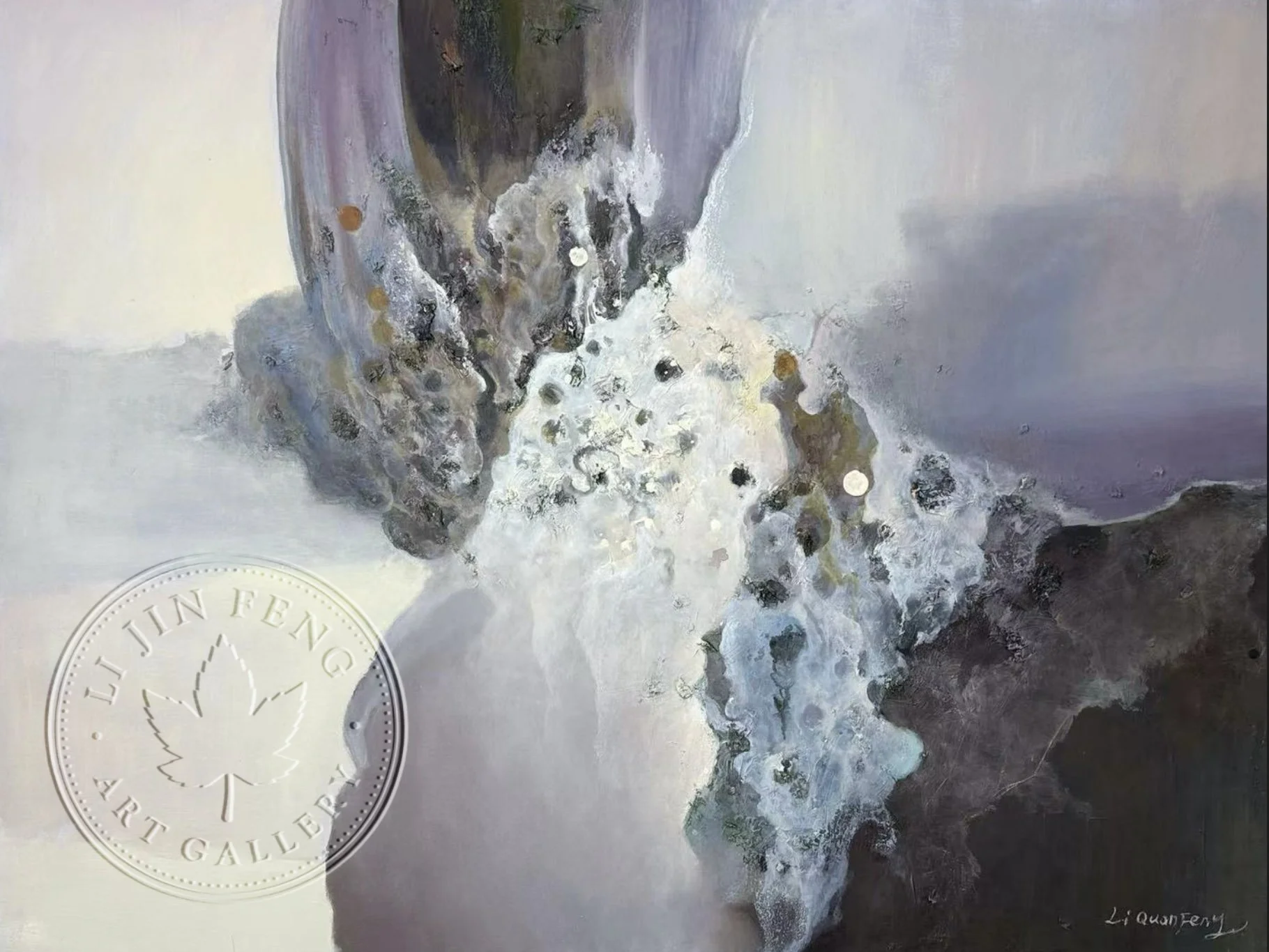
水与星尘
画作介绍
当画布上的白与紫、灰与黑开始流动、彼此呼吸,我们便步入一个既属于溪涧、又属于星云的场域——在《水与星尘》中,画家以颜料的震颤,让自然与宇宙之间的隐秘对话得以显形。
他并未以写实的笔触去捕捉一汪具象的泉,或某片确定的星云;相反,他让笔触成为“意象”的使者——堆叠的白,是山涧跌落时破碎的浪,也是银河旋涡中奔逸的尘光;深浅交错的灰紫,既似岩石的褶皱,也如星系的光晕;那些闪烁的微点,宛如浪尖跃出的碎金,同时又指向宇宙背景中脉冲星的节奏。
在此,他以独特的“意象画法”,将水墨的“留白”与“气韵”织入油画的肌理。
水墨的“虚”,被转译为朦胧的雾感——那并非空白,而是水汽、是引力场、是万物之间看不见却始终存在的联结;油画的“实”,则化作笔触之“骨”:厚涂的力量塑造浪的张力,刮擦的纹理刻画石的韧性,使每一次起伏都带着流动的即时性,也带着永恒的回声。
这正是画家的个人语言:他不画“物”,而画“物与物之间的关系”。
水如何削切岩石,星子如何在宇宙中洇散,自然的微观脉动又如何与宇宙的宏观节律暗暗同频——这些看不见的关联,在他的画布上被重新赋形。
于是在他笔下,溪涧的轰鸣与星云的旋转共享一种深层的频率;颜料的颗粒既是浪花的泡沫,也是星际物质的尘埃。
观者无法分辨自己是在低头凝视泉水,还是在仰望遥远的星群,只能在这一团流动的色彩里,目睹科学的“共鸣”与美学的“意境”悄然交汇。
艺术的价值,从来不在于复刻自然,而在于让我们在画布上触到“温度”与“脉搏”——水的温度、星的脉搏。
在这幅画中,“小”的自然与“大”的宇宙折叠进同一笔触里:每一滴浪都隐含着一颗星的诞生,每一块岩石都回映着星系的构造。而观者自身,也不再只是旁观者,而是成为这一场静谧共鸣中的参与者
90X120cm
当尺度被折叠、界限被抹平,观看便不再是对景物的辨认,而是一场感知的进入。《水与星尘》由此展开——画家以震颤的笔触与流动的色彩,在画布上搭建起一处介于溪涧与星云之间的场域。这里,水的流向与星的运行彼此呼应,微观与宏观共享同一节律,引导观者在静默的凝视中,触及自然与宇宙相互共振的深层脉搏。
Water and Stardust
Introduction
As the whites and purples, grays and blacks on the canvas begin to flow and breathe together, we step into a realm belonging both to mountain streams and star clouds. In Water and Stardust, the artist uses the trembling of paint to reveal the hidden dialogue between nature and the cosmos.
He does not aim to capture a specific pool of water or a particular nebula with realistic brushwork. Instead, his strokes act as messengers of “imagery”: the layered whites represent both the shattered waves of a mountain stream and the drifting dust of a galactic spiral; the interwoven grey-purples suggest rock folds as much as the halos of distant galaxies; the flickering specks are like golden sprays atop waves, yet also echo the rhythm of pulsars in the cosmic background.
Here, he employs a unique “imagery technique,” weaving the liubai (emptiness) and qi-yun (spirit resonance) of ink painting into the textures of oil paint. The “void” of ink transforms into mist—a presence that is not emptiness, but water vapor, a gravitational field, a hidden connection pervading all things. The “substance” of oil paint becomes the skeleton of the work: thick strokes shape the tension of the waves, scraped textures capture the resilience of stone, giving each rise and fall both the immediacy of movement and the echo of eternity.
This is the artist’s personal language: he does not paint “objects,” but the relationships between them. How water carves rock, how stars disperse across the cosmos, how the micro-rhythms of nature subtly resonate with the macro-rhythms of the universe—these unseen connections are reshaped on his canvas. In his work, the roar of streams and the rotation of nebulae share a deep frequency; the grains of paint are at once froth atop waves and dust of interstellar matter. The viewer cannot tell whether they are gazing downward at water or looking up at distant stars—only witnessing, within the flow of color, the quiet convergence of scientific “resonance” and aesthetic “poetic spirit.”
The value of art has never been in replicating nature, but in allowing us to feel “temperature” and “pulse” on the canvas—the warmth of water, the pulse of stars. In this painting, the “small” of nature and the “vast” of the universe are folded into a single stroke: each droplet of water hints at the birth of a star, each stone reflects the structure of galaxies. The viewer ceases to be a mere observer, becoming a participant in this silent resonance.
90X120cm
When scale is folded and boundaries erased, seeing ceases to be mere recognition of forms and becomes an act of entering perception. Water and Stardust unfolds from this premise—the artist, with trembling brushstrokes and flowing color, constructs on the canvas a realm suspended between mountain streams and star clouds. Here, the flow of water echoes the motion of stars; microcosm and macrocosm share the same rhythm, guiding the viewer, in silent contemplation, to sense the deep resonance between nature and the universe.
浪与空
90X120cm
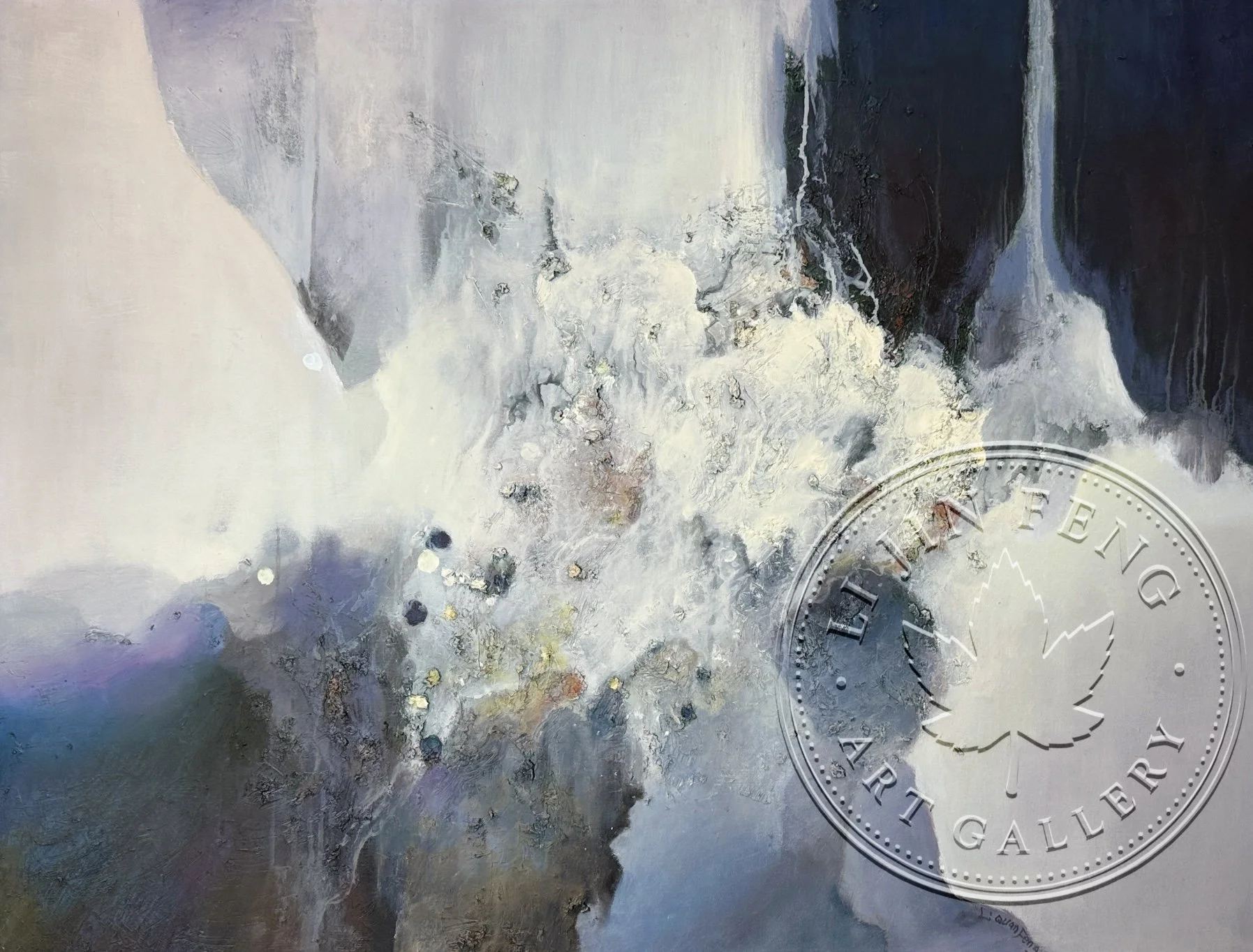
当白色的力量在深黑之中缓缓推进,画面便不再指向某一处风景,而开启了一场关于生成、时间与秩序的沉思。这件作品并不试图讲述自然的表象,而是以油彩的厚度与留白的呼吸,构筑出一个可供进入的思考场域——在流动与恒定、显现与隐匿之间,邀请观者感知自然法则如何与人的经验悄然共振。
画作展示
在这幅作品中,白色的能量并非单纯地铺陈,而是以一种“生成”的姿态向深黑的褶皱推进,仿佛自然力量在沉默的岩壁间寻找自己的路径。浅紫微雾绕着山石的轮廓散开,使画面在密与疏之间悬浮出一种独特的“气场”——这不是景象的再现,而是李泉枫以油彩构筑的思想实验,将人类的经验与自然的法则置于同一块画布上对照。
他并不意图解释什么规律,也不提供明确的叙事;相反,他让形体与笔触承担起“推理”的角色:
白色的层叠像时间的涌动,既轻盈又执拗;深黑的稳重则呈现一种近乎地质学般的恒久,仿佛自然界沉默的底律;而那些隐约闪现的光点,与其说是浪花的碎片,不如说是万物演化过程中偶然显现的秩序性闪光——提醒着观者在无序之中仍有轨迹可循。
作品最大的魅力,在于它并不强调可视的对象,而是以油画的厚度和肌理打开了一种“思考空间”。从中国水墨传统中借来的“留白与空灵”转化为画面中漂浮的紫雾,使观者有一种进入思想缝隙的错觉;而油彩的重量与刮痕则像时间在物质上刻下的纹理,让人生的折线与宇宙的年轮在无形处互相呼应。
李全凤的艺术一贯呈现这样的双向凝视:既向内探问个体在流动命运中的位置,也向外追索自然运作的深层逻辑。在这幅作品里,你无法确切分辨那些白色究竟是拍岸的潮,还是心境的激荡;浅紫究竟是雾气,还是对不确定性的温柔包容。正是这种模糊,使画面从物象中抽离出来,成为一种介于哲学与感受之间的语言。
最终,画布呈现的是一种静谧的融合:流动的白描绘了无常的形态,沉稳的黑诉说着恒定的力量,而两者之间的张力构成了作品真正的中心。在这里,自然法则不再是冷冰冰的理论,而是与人的情绪、思考、韧性共同震动的存在——在浪、雾、光、影的交叠间,观者得以触及属于自己的那道“内在秩序”。
Waves and Void
90X120cm
When the force of white slowly advances within the depths of black, the canvas ceases to point to any single landscape, opening instead a meditation on creation, time, and order. This work does not seek to depict the surface of nature; rather, through the density of oil paint and the breath of negative space, it constructs a contemplative field into which the viewer may enter—inviting one to sense how the laws of nature quietly resonate with human experience, suspended between movement and permanence, revelation and concealment.
Introduction
In this work, the white energy does not merely cover the canvas—it advances into the folds of deep black with a generative force, as if nature quietly seeks its path along silent cliffs. Pale purple mist drifts around the rocks, suspending the composition between density and openness, creating an aura—not a depiction of scenery, but Li Quanfeng’s conceptual experiment, placing human experience and natural law on the same canvas.
He does not explain rules or narrate; form and brushstroke become reasoning: layered white evokes time’s surge, light yet persistent; deep black conveys near-geological permanence; and faint points of light hint at emergent order within chaos.
The work’s power lies in creating a “space for thought” through paint’s thickness and texture. Borrowing from Chinese ink, drifting purple mist evokes emptiness; the weight and scratches of paint act as time’s imprint, letting human experience and cosmic rhythm resonate invisibly.
Li Quanfeng’s art looks both inward and outward: questioning our place in the flow of fate while tracing nature’s deep logic. Whites may be waves or stirrings of the mind; purple, mist or gentle acceptance of uncertainty. This ambiguity lifts the work beyond objects, forming a language between philosophy and sensation.
Ultimately, flowing whites depict impermanence, steady blacks enduring force, and their tension forms the painting’s core. Here, nature’s laws vibrate with human emotion and thought; amid waves, mist, light, and shadow, viewers can sense their own “inner order.”